
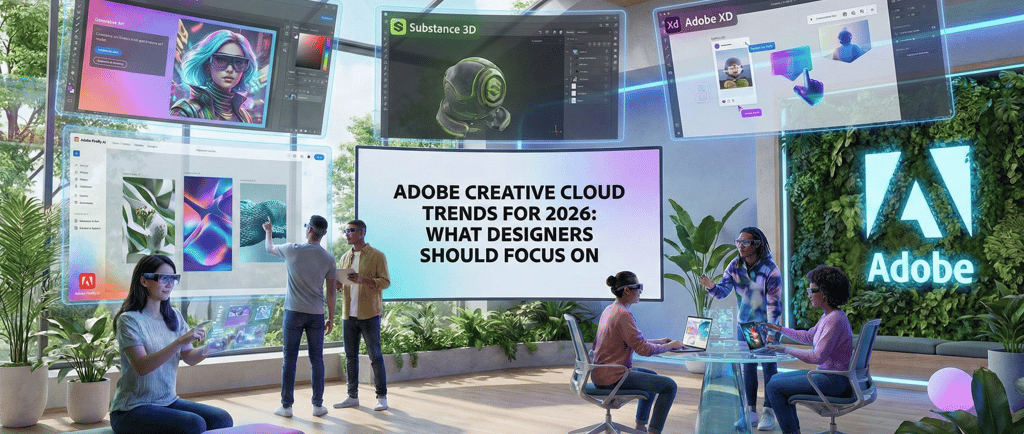
Adobe Creative Cloud Trends for 2026: What Designers Should Focus On
A look at key Adobe Creative Cloud trends for 2026, including AI-driven design, collaboration, and how creative teams can work faster without losing control.
1/26/20262 min read
Introduction
Creative teams are under constant pressure to deliver more content, faster, across more channels, without compromising quality or brand consistency. In response, Adobe Creative Cloud has evolved well beyond a collection of design tools. By 2026, it has become a connected creative platform where AI, collaboration, and asset management work together to support real production environments.
For designers, agencies, and in-house marketing teams, the question is no longer whether to use Adobe Creative Cloud, but how to use it effectively. This article outlines the key trends shaping Creative Cloud in 2026 and what designers should focus on to stay relevant and productive.
AI Is Now a Daily Design Assistant
AI inside Creative Cloud is no longer experimental. Features powered by Adobe Firefly are embedded directly into tools like Photoshop, Illustrator, and InDesign.
Designers now routinely use AI for:
Background removal and image cleanup
Generating variations of visuals
Faster mockups and ideation
Refining layouts and compositions
These tools reduce repetitive work, allowing designers to spend more time on creative judgment and less on manual execution.
Designers who treat AI as a starting point, not a final output, are seeing the biggest gains.
Speed and Iteration Matter More Than Perfection
In 2026, creative work is increasingly iterative. Marketing campaigns, social content, and digital assets evolve continuously based on performance data.
Adobe Creative Cloud supports this shift by:
Enabling quick edits across multiple formats
Allowing non-design stakeholders to review and comment in real time
Reducing friction between design and marketing teams
The focus has shifted from perfect first drafts to fast cycles of improvement.
Collaboration Has Become a Core Requirement
Creative teams are no longer centralised. Designers, marketers, agencies, and clients often work across locations and time zones.
Creative Cloud collaboration features now support:
Shared libraries for brand assets
Version history and change tracking
Commenting and approvals inside design files
This reduces dependency on email threads and disconnected feedback, helping teams move faster with fewer errors.
Asset Management Is Critical for Growing Teams
As creative output grows, managing assets becomes a business challenge. Files spread across devices and platforms create risk and inefficiency.
Adobe’s integrated asset management helps teams:
Maintain a single source of truth
Control access to sensitive brand materials
Reuse assets efficiently
For organisations scaling their creative operations, structured asset management is no longer optional.
Designers Are Expected to Work Across Disciplines
Modern designers are expected to:
Understand brand strategy
Work closely with marketing and product teams
Design for multiple platforms and formats
Creative Cloud supports this by integrating tools for graphics, video, motion, and UI under one ecosystem, reducing context switching and tool fragmentation.
Licensing and Cost Control Are Under the Spotlight
As Creative Cloud usage expands, so does licensing complexity. Many organisations struggle with:
Over-licensed or underutilised seats
Inconsistent access across teams
Poor visibility into usage
This is where managed services become valuable.
How Intellinx Supports Creative Teams
Intellinx helps organisations get more value from Adobe Creative Cloud by:
Assessing actual usage and role requirements
Structuring licenses to match team needs
Securing creative assets and access
Supporting onboarding and scaling
Our approach focuses on productivity, governance, and cost clarity.
What Designers Should Focus On in 2026
Designers who thrive in 2026 will:
Use AI to speed up execution, not replace creativity
Embrace collaboration as part of the design process
Understand brand systems and asset reuse
Work closely with business and marketing teams
Creative Cloud supports this evolution, but success depends on how teams use it.
Conclusion
Adobe Creative Cloud in 2026 reflects how creative work actually happens today: fast, collaborative, and increasingly AI-assisted. Designers who adapt their workflows to these realities will remain valuable and effective.
If your organisation wants to optimise Creative Cloud usage, manage licenses better, or support growing creative teams, Intellinx can help you build a setup that scales without friction.
Contact
Phone
support@intellinx.co.in
+91-7666078889
Copyright© 2026 Intellinx Cosnulting llp. All Rights Reserved.